Juho Suokas & Erja Vottonen, University of Eastern Finland
Siirry tästä suomenkieliseen versioon
Translation in research work
Translators, interpreters, and language editors (hereon collectively referred to as language service providers, LSPs) do important yet often invisible work. One good example of this are scientific publication processes: research work is often portrayed as an English-language monolith, yet research contexts and the researchers behind scientific publications are diverse and multilingual.
Most researchers use English to communicate their work but speak other first languages and do their research outside English-speaking contexts. Thus, translation is a major part of research work, yet it is often invisible and mostly done by the researchers themselves. Regardless of this common self-translation in academia, professional language services also play a notable role in scientific publication processes – most commonly in the form of language revision, at least in Finland.
Our ReTra research group has examined the phenomenon of translation and multilingualism in research work. This blogpost is based on discussions in a workshop arranged with the Nordic Editors and Translators organization (NEaT) in January 2026. We also refer to our research material, where we have interviewed researchers and LSPs working with researchers.
How do researchers see translation?
In our interviews, researchers seem to think of language and translation in roughly one of two distinct ways: On one hand, translation is seen by some researchers as a mechanical process of meaning transfer, where correct solutions exist, language is a communication tool, and language tasks can be delegated to technological solutions. On the other hand, many researchers also see translation as a process of producing something inherently different than the source text, and that language is not just communication of messages, but also a way to make sense of and shape one’s reality. These latter researchers may regard translation as a creative process where meaning is interpreted and recreated. However, not all researchers fall neatly within one category or the other, this is more a spectrum between two distinct views.
As you might expect, the conceptualizations of translation are different between researchers and LSPs. The latter offer a more dynamic perspective: they emphasize how each translation must be seen in its communicative context, and translation can also be seen as communication between different cultural ecosystems.
Interaction and balancing acts
Researchers may not be aware of what language services are available and what to expect from them. For instance, questions of how long does it take to translate or do language revisions and how much does it cost – or even whether their work has budgeted for language services.
In our interviews, LSPs describe interaction with researchers as a balancing act. Without communication with the researchers, it can be difficult to know what is expected from the work: for instance, whether the focus should be solely on a ‘superficial’ linguistic level, or whether the text can be modified more extensively.
There is also the question of how to draw the line between the roles of the researcher and language professional. The LSPs wished that researchers could just focus on what they are good at and leave language matters to them.
Returning clients were described to have most interaction with LSPs. In addition, early-stage researchers seem to be the ones who wish for the most communication and feedback, as they wish to improve their writing, whereas more established researchers might be hesitant to discuss – or even accept – changes to their writing. The workshop participants also mentioned that they would also like more feedback. A common problem was that the LSP assumed they had improved the text, but the researchers thought that it did not conform to the writing practices of their field. In such cases, better communication could help avoid such problems and aid in developing both researchers and the LSPs to write in specific fields.
Thus, it is a balancing act.
Technological products or human processes?
The discussion on developments in language technology is a hot topic in both research and language professions. Whether and when technology will replace language professionals is an ongoing debate, yet it is far from a new one. The constant need to adapt to technological changes is endemic to the field of language services – from pen-and-paper work to typewriters to computer-assisted translation, LSPs have constantly been adapting to changes and keep their relevance to this day.
Our interviews suggest that LSPs are still needed and valued in academia – although researchers increasingly utilize language technology for translation and language revision. Still, many researchers emphasized the need for human language services in publication process – especially in the final stages. This was greeted by our seminar participants as a hopeful piece of information in a field where discussions of the future are often clouded by gloomy premonitions.
One of our seminar participants compared using automated language tools and human language services to buying clothing from a fast fashion store and having a tailor-made outfit for a special occasion – both garments have different uses and not everyone can afford local artisan work. Similarly academic publishing can be seen as a process that may often call for something more “premium” and handmade – especially if the researcher has access to funds to pay for such services. On the flipside, both fast fashion and technological solutions share similar environmental and societal problems.
One key difference the participants identified between technological solutions and professional language services was the possibility for human interaction, including the possibility to challenge the work done by either the researcher or language professional. AI-tools were be seen as something of a “yes-person”, who likely gives ungrounded positive support to the authors rather than knowing when to offer constructive criticism.
Unique human interaction, constructive feedback, and possibilities for negotiations were seen by the LSPs as something that they can offer to the researchers and how they can help produce better publications. Similarly, there was discussion of different ethical aspects when using AI compared to human language services, including confidentiality, ideological bias, and use of natural resources – all of which favor human labor as the more ethical choice.
Finally
As academic work revolves largely around thinking, including examining and challenging different ideas, we noticed that researchers commonly do not wish to outsource and delegate their thought processes to automation. Similarly, as language use such as writing is seen as a part of the thinking process, human effort is appreciated and utilized in language matters too. Language experts can offer the thought processes behind their translation and language revision work, be open about them, and offer the possibility to challenge both their thought processes as well as those of the researchers. This possibility to communicate, question, think, and interpret is a key factor of scientific publication that neither researchers nor LSPs wish to externalize for technological automation – technology, which replaces thinking and semiotic action with calculations of statistical probabilities, as Riku Haapaniemi described in his previous blog post (in Finnish).
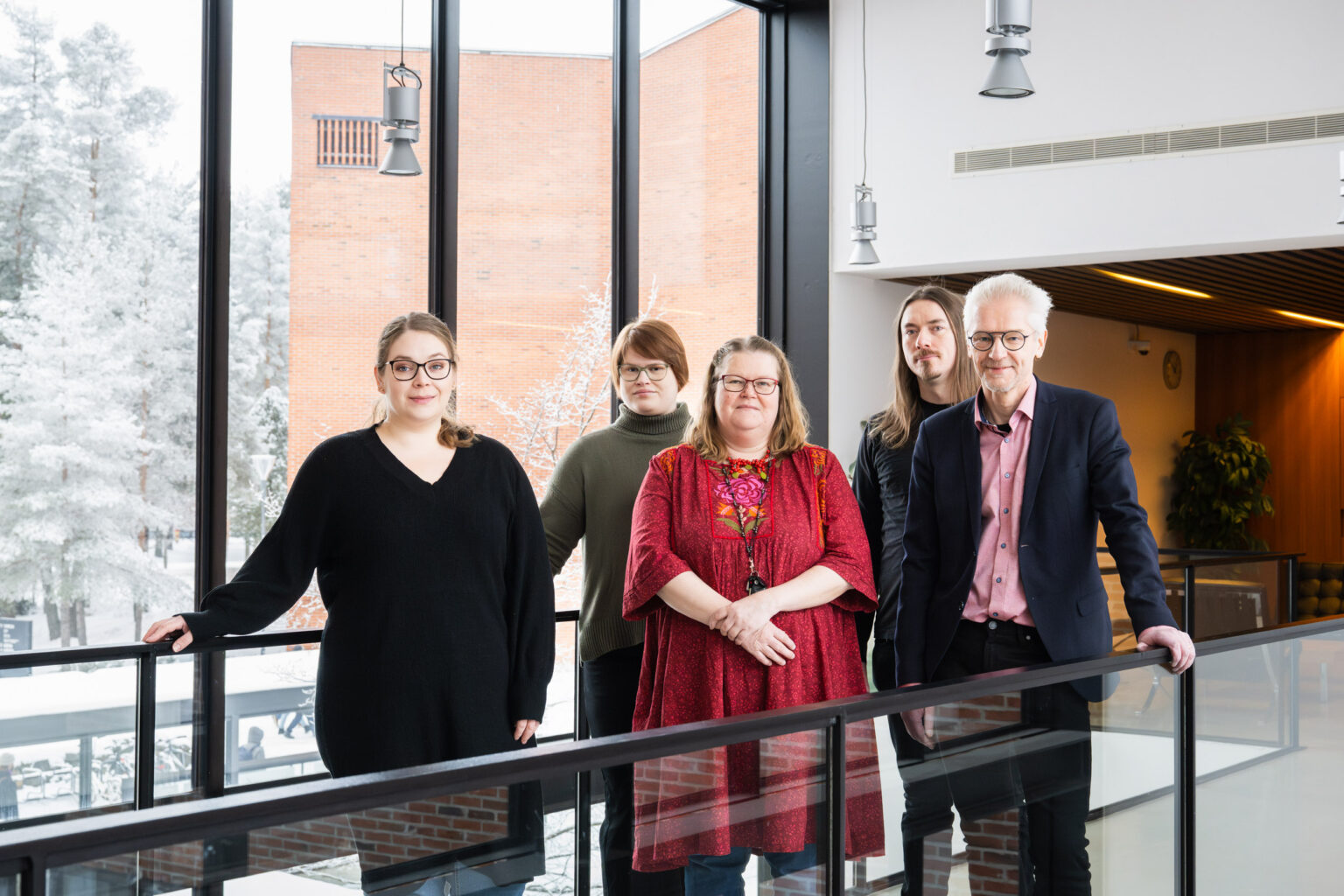
Article photo courtesy of University of Eastern Finland. ReTra project team from the left: Erja Vottonen, Elina Kainulainen, Helka Riionheimo, Juho Suokas, Eppu Penttilä.

Juho Suokas & Erja Vottonen
Post-doctoral researchers
Juho Suokas and Erja Vottonen work as post-doctoral researchers at the University of Eastern Finland (UEF) in research project “Multilingualism and translation in researcher’s changing work” funded by Kone Foundation (2024 – 2027). In the project, we study the role of multilingual communication in research work and the translatorial nature of the research process. This includes the many forms of interlingual communication in research, which is done by professionals, non-professionals, paraprofessionals, and technological tools.
The other members of the project are Eppu Penttilä (head of the project), Helka Riionheimo and Elina Kainulainen.
More about our research project:
https://sites.uef.fi/retra/?lang=en
Photos: Niko Jouhkimainen (UEF)